



- SPEECH
Inflation deviations and monetary policy
Keynote speech by Philip R. Lane, Member of the Executive Board of the ECB, at the 15th workshop on exchange rates, co-organised by Banka Slovenije with the Banca d’Italia, the Bank for International Settlements, the European Central Bank and the Nationale Bank van België/Banque Nationale de Belgique
Ljubljana, 3 December 2025
It is an honour to participate in this excellent workshop on exchange rates and to visit Bank of Slovenia.
This speech has two parts.[1] In the first part, I will discuss the appropriate monetary policy response to deviations of inflation from the ECB’s symmetric two per cent medium-term target. In the second part, I will turn to the topic of this conference and outline some analytical perspectives on the interplay between the exchange rate and monetary policy.[2]
Inflation deviations and monetary policy
The ECB has a clear orientation for the conduct of monetary policy: a symmetric two per cent inflation target over the medium term. This is articulated in our monetary policy strategy statement as follows:
“The Governing Council considers that price stability is best maintained by aiming for two per cent inflation over the medium term. The Governing Council’s commitment to this target is symmetric. Symmetry means that the Governing Council considers negative and positive deviations from this target as equally undesirable. The two per cent inflation target provides a clear anchor for inflation expectations, which is essential for maintaining price stability.”
In pursuing the symmetric two per cent target, a working definition of the medium term is required. Our monetary policy strategy statement provides a nuanced description:
“The flexibility of the medium-term orientation takes into account that the appropriate monetary policy response to a deviation of inflation from the target is context-specific and depends on the origin, magnitude and persistence of the deviation. Subject to maintaining anchored inflation expectations, it also allows the Governing Council in its monetary policy decisions to cater for other considerations relevant to the pursuit of price stability.”
How should such high-level strategic guidelines be implemented in practice? Let me make a few comments.
It is straightforward that small inflation deviations that are not expected to persist do not call for a monetary policy response. Most obviously, lags in the transmission of monetary policy mean that it would be counterproductive to seek to respond to near-term deviations that are solidly expected to be transitory. Moreover, a small and transitory deviation is unlikely to trigger the adjustment dynamics that can turn temporary deviations into longer-lasting deviations.
At the other extreme, it should also be clear that a sufficiently large and persistent deviation from the target requires a monetary policy response, regardless of its origin.
First, through the cost-of-living channel, the current inflation rate may influence subsequent price and wage-setting, as firms and workers respond to lower cost pressures in relation to negative deviations and higher cost pressures in relation to positive deviations.
Second, the real interest rate channel can reinforce an inflation shock that is expected to display some persistence: if a drop in inflation today is associated with ongoing low inflation for, say, the next year or two, this translates into a higher real interest rate (nominal rate minus expected inflation) over the relevant horizon. In turn, this puts downward pressure on consumption and investment, adding to the disinflationary impulse. Symmetrically, above-target inflation that is expected to persist for some time maps into a lower real interest rate and amplifies inflationary pressures.
Third, a persistent shift in the inflation rate can influence the formation of inflation expectations if people put some weight on simple extrapolation in forming expectations. Under such extrapolative behaviour, if inflation runs below target for a year or two, there is some risk that people might revise down their beliefs about the de facto medium-term inflation target. Symmetrically, if inflation runs above target for a year or two, there is some risk that people might revise up their beliefs about the de facto medium-term inflation target.
Fourth, a material inflation deviation that does not trigger a monetary policy response poses a communication risk, since markets, firms and households may find it difficult to understand the reaction function if there is no reaction.[3] In turn, greater uncertainty about the reaction function can give rise to higher volatility in expectations about inflation and the policy rate path.
Given these mechanisms, a material deviation of inflation from the target calls for a monetary policy response. Since the cost-of-living, real interest rate, expectations-deanchoring and communication channels operate in a plausibly non-linear manner (individually and collectively), the appropriate monetary policy is also non-linear, with an incremental adjustment to mid-sized deviations but a more forceful or persistent adjustment to large deviations.
This non-linearity is recognised in our monetary policy strategy statement, which highlights that:
“To maintain the symmetry of its inflation target, the Governing Council recognises the importance of appropriately forceful or persistent monetary policy action in response to large, sustained deviations of inflation from the target in either direction, to avoid deviations becoming entrenched through de-anchored inflation expectations.”
How should monetary policy respond to material deviations that fit neither the “small, transitory” category that can clearly be ignored, nor the “large, sustained” category that clearly triggers a non-linear response that is appropriately forceful or persistent? For this intermediate category of “mid-sized, somewhat persistent” deviations, the origin of the inflation deviation should play an important role in determining the appropriate monetary policy reaction.[4]
In particular, an intermediate-category broad-based inflation deviation likely calls for an incremental adjustment in the monetary stance. In essence, this is the standard prescription of monetary policy feedback rules (such as the “family” of Taylor rules). However, if the origin of the inflation deviation is a supply-driven relative price level shock, the case for an active monetary policy response is more nuanced.[5]
In particular, a supply shock to the relative price level of energy does not pose the same risk to medium-term inflation as a shock to domestic demand.
While an intermediate-category shock to the relative price level of energy may visibly alter headline inflation for a substantial fraction of the projection horizon (energy comprises about 10 per cent of the overall Harmonised Index of Consumer Prices (HICP)), it might not materially alter the broader underlying inflation dynamics that are most important in determining the medium-term inflation trend. In particular, an intermediate-category supply-driven relative energy price level shock might not be sufficiently large or persistent to generate a broader wave of price changes, with energy-using sectors choosing to absorb the cost shock in margins rather than passing it through to the consumer.
The impact of a supply-driven relative price level shock on overall inflation also tends to have an inbuilt, self-correcting element. For instance, a decrease in the relative price level of energy will boost activity levels in energy-using sectors, with less slack in the economy putting upward pressure on inflation over the medium term. More broadly, since energy has a high import content, a decrease in the relative price level of energy typically constitutes an improvement in the terms of trade, boosting the real incomes and consumption levels of euro area households and thereby further adding to medium-term inflation pressures. In the opposite direction, symmetric mechanisms apply in relation to a positive shock to the relative price of energy.
These considerations mean that, within the intermediate category, a supply-driven inflation deviation that is primarily sectoral in origin does not pose the same risk to the medium-term inflation target as a broad-based inflation deviation. This means that it is essential in determining the appropriate monetary policy stance to carefully analyse the realised and projected dynamics of supplementary inflation measures, such as non-energy inflation (the sum of all categories excluding energy) and core inflation (further excluding the food category).[6]
Clearly, it is a judgement call to determine how to respond to intermediate-category inflation deviations. Such judgement calls are best made on a meeting-by-meeting, data-dependent basis that draws on a comprehensive and rigorous analytical framework to take account of the unfolding evidence in relation to the shocks driving inflation deviations, and whether there are incipient signs that relative price shocks are transforming into broader inflation dynamics. This meeting-by-meeting, data-dependent approach is especially helpful under conditions of elevated uncertainty.
This analytical framework necessarily involves inspecting and modelling the current and projected behaviour of wages, profit margins, the suites of underlying inflation indicators and indicators of inflation expectations to assess whether a moderate inflation deviation might turn into a larger or longer deviation. It also involves a wide-ranging risk assessment. Amongst other dimensions, an important set of risk scenarios relates to possible amplification shocks, by which an inflation deviation might grow larger or become more persistent. This means that upside inflation shocks are especially salient if the baseline exhibits a positive inflation deviation. Symmetrically, downside inflation shocks are especially salient if the baseline exhibits a negative inflation deviation.
In summary, this discussion has emphasised that the appropriate monetary policy response to an inflation deviation from the target is context specific and requires a careful analysis of a broad set of considerations. Of course, the capacity to consider “looking through” some types of inflation deviations depends on a strong institutional commitment to delivering the symmetric inflation target over the medium term, underpinning firmly-anchored medium-term inflation expectations.[7]
The interplay between the exchange rate and monetary policy
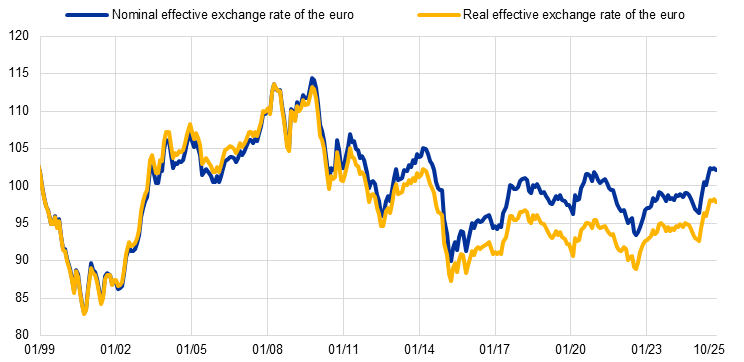
Let me now switch gears and turn to the interplay between the exchange rate and monetary policy. Chart 1 shows the nominal and the real effective exchange rates of the euro against 18 major trading partners, indexed against their values in 1999. While there have been prolonged and substantial currency swings over the lifetime of the euro, there has been no clear overall trend with currency shifts tending to reverse over time.
Chart 1
Nominal effective exchange rate and real effective exchange rate of the euro
(index: Q1 1999 = 100)
Sources: ECB and ECB staff calculations.
Notes: Nominal effective exchange rate and real consumer price index (CPI)-deflated effective exchange rate, denominated in euro, for 18 trading partners.
The latest observations are for October 2025.
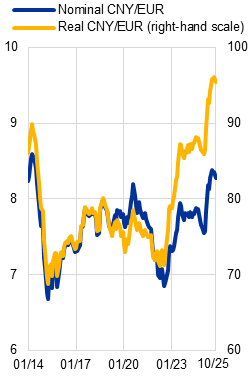
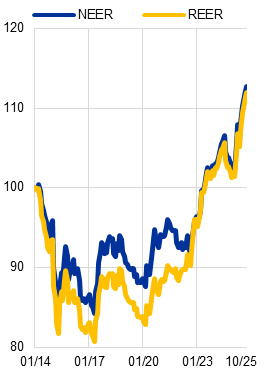
Chart 2 zooms in on the last decade and shows the euro exchange rate against the US dollar, the Chinese renminbi and a basket of selected Asian currencies since 2014. Since the start of the hiking cycle in Summer 2022, there has been marked appreciation of the euro against these major trading partners. For the renminbi in particular, this appreciation has been even stronger in real terms than in nominal terms, reflecting the much larger cumulative inflation in the euro area relative to China during this period.
Chart 2
The euro against the US dollar, Chinese renminbi and Asian currencies
Nominal and real USD/EUR | Nominal and real CNY/EUR | Effective exchange rates for the euro against selected Asian currencies |
|---|---|---|
(USD per EUR) | (CNY per EUR) | (index: 31/01/2014 = 100) |
 |  |  |
Sources: Bloomberg, ECB and ECB staff calculations.
Notes: Panel a): The real USD/EUR refers to the CPI-deflated bilateral exchange rate (right-hand scale). An increase denotes an appreciation of the euro. Panel b): The real CNY/EUR refers to the CPI-deflated bilateral exchange rate (right-hand scale). An increase denotes an appreciation of the euro. Panel c): Nominal effective exchange rate and real (CPI-deflated) effective exchange rate, denominated in euro, for selected Asian trading partners (Japan, South Korea, Indonesia, India, Malaysia, Philippines, Taiwan and Thailand). Corresponding trade weights are normalised to one. EUR NEER refers to the nominal effective exchange rate of the euro and EUR REER refers to the real effective exchange rate of the euro, The latest observations are for October 2025.
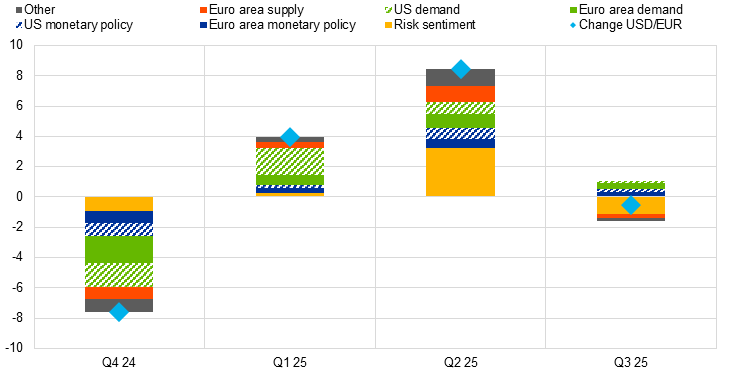
Chart 3 zooms in further by examining the evolution of the dollar-euro exchange rate over the last year (Q4 2024 through Q3 2025) in the context of a BVAR model maintained by ECB staff. A striking feature of this analysis is the contribution of risk sentiment to euro appreciation in Q2 2025, reflecting some mix of a decline in risk sentiment towards the dollar and an improvement in risk sentiment towards the euro.
Chart 3
BVAR historical decomposition of the drivers behind the USD/EUR exchange rate
(percent, increase = appreciation of the EUR)
Sources: Haver and ECB staff calculations.
Notes: The model extends the Bayesian Vector Autoregression (BVAR) of Farrant and Peersman (2006) to include seven endogenous variables: USD/EUR, relative GDP, relative CPI, relative two-year yields (euro area-United States), euro area GDP, euro area CPI and euro area two-year yields. Quarterly data (from the first quarter of 1999 to the third quarter of 2025) are entered in first differences. It includes four lags and a constant, estimated via Bayesian methods following Korobilis (2022). A tightening euro area (US) monetary policy shock is assumed to increase euro area (US) interest rates more than in the United States (euro area), reduce euro area (US) GDP growth and inflation more than in the United States (euro area), while causing the euro to appreciate (depreciate) against the dollar. A risk sentiment shock assumes that stronger investor sentiment towards the euro causes the euro to appreciate, weighing on inflation and growth, which lowers euro area yields (more than US yields). Latest missing GDP observations are projected; shocks are identified via sign restrictions. The latest observations are for the third quarter of 2025.
Transmission of the exchange-rate: model-based impact
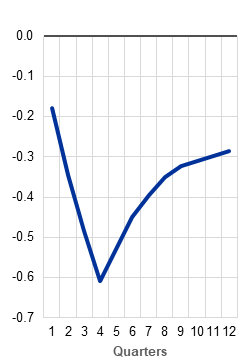
Model-based analysis allows for a broader analysis of the transmission of exchange rate changes on the key macroeconomic variable. Simulations based on the ECB’s semi-structural multi-country model indicate that a 10 per cent appreciation in the euro plays out over several years, with inflation markedly lower for about three years and a peak disinflation impulse of 0.6 percentage points after about a year.[8] The level of GDP declines throughout this adjustment period, with a cumulative loss of about one per cent of GDP after three years. In relation to trade dynamics, the euro appreciation reduces export volumes by about 3 per cent over this horizon and import volumes by about 1.5 per cent.
In the model, the transmission of the exchange rate shock operates primarily through the effects on trade deflators, which in turn influence export and import volumes. The appreciation makes euro area exports more expensive on international markets, reducing export volumes. At the same time, the appreciation also lowers the price of imports, dampening domestic inflationary pressures. Overall, imports decline despite the reduction in import prices as the demand drag dominates, with both private consumption and investment decreasing: consumption falls as economic activity contracts and labour demand slows. Investment declines as higher real interest rates and the appreciation’s disinflationary effects take hold. The resulting drop in the relative price of investment goods further suppresses investment, especially in externally exposed sectors.
Chart 4
Impulse responses to a 10 per cent euro appreciation in the ECB Multi-Country Model
HICP inflation | Real GDP | Real exports | Real imports |
|---|---|---|---|
(percentage point deviation from steady-state year-on-year growth rate) | (percentage deviation from steady state) | (percentage deviation from steady state) | (percentage deviation from steady state) |
 |  |  |  |
Sources: ECB staff calculations based on ECB-MC model simulations; see Angelini, E. et al. (2025), “The ECB-Multi Country Model: A semi-structural model for forecasting and policy analysis for the largest euro area countries”, Working Paper Series, No 3119, ECB, Frankfurt am Main.
Transmission of the exchange-rate: financial conditions
It is important to analyse the impact of currency movements using a range of different approaches. In addition to standard macroeconomic models, it is also helpful to study the impact of the exchange rate on financial conditions. In particular, currency movements operate via financial channels in addition to trade channels by altering the relative wealth of domestic investors versus foreign investors and affecting home and foreign asset prices.
Chart 5 shows the contribution of the exchange rate to the “Macro-Finance” financial conditions index (MF-FCI) that has been developed by ECB staff. [9] While the exchange rate only accounts for a relatively minor proportion of the total variation in the MF-FCI, it still adds significant explanatory power on top of the contributions of nominal and real interest rates and risk asset prices.[10]
In the run-up to the global financial crisis, euro appreciation added to the tightening of financial conditions in the euro area. During the European debt crisis and in its aftermath, the weaker euro reinforced the generally accommodative monetary policy by contributing to the loosening of financial conditions. Since 2017, the regained strength of the euro has tightened financial conditions to varying degrees. Most recently in 2025, the euro has recorded its strongest tightening impulse on the MF-FCI , partly explained by the relative weakening of the US dollar.
Chart 5
Euro exchange rates in the Macro-Finance FCI
(left-hand scale: regression coefficient; right-hand scale: percentage)

Source: Bletzinger T., Martorana, G. and Mistak, J. (forthcoming).
Notes: The chart shows the estimated weight of the euro nominal effective exchange rate (NEER) in the baseline specification of the Macro-Finance Financial Conditions Index (hollow bar) and its relative weight among the nine asset prices included (hollow diamond). The filled bars and diamonds refer to the estimates of an alternative specification in which the nominal effective exchange rate is replaced with five bilateral euro exchange rates.
In the baseline version of the MF-FCI, the coefficient of the euro NEER is positive, in line with the notion that an appreciation in the euro tends to tighten financial conditions in the euro area (Chart 5, hollow bar). A benefit of the methodology underlying the new index is its flexibility in estimating other specifications. The coefficients in the baseline do not only resemble average effects over the estimation sample from 2007 until 2025, but possibly also across underlying variables. In the case of the NEER, a meaningful model extension substitutes the NEER with euro exchange rates (Chart 5, filled bars). The positive average coefficient of the NEER is primarily driven by the EUR/USD, pointing to the importance of the US dollar for global financial markets and the relevance of a stronger euro relative to the US dollar as a dampener of the euro area economy. By contrast, a stronger euro relative to the Chinese renminbi indicates a loosening of financial conditions. Finally, a stronger euro relative to the Swiss Franc is also associated with a loosening of financial conditions, which is consistent with the special status of the Swiss France as a safe haven currency that weakens during “risk on” phases.
Model-based impulse responses to a surprise monetary policy expansion
Finally, it is also important to understand how the exchange rate responds to monetary policy decisions. In what follows, I show model-based simulations of a surprise monetary policy easing carried out by ECB staff. The simulations use the ECB-BASE and New Area-Wide Model (NAWM) models, which treat the euro area as a small, open economy, as well as a two-region model calibrated on the euro area and the rest of the world (GMGS henceforth).[11] All three models account for changes in trade and asset flows across regions following changes in euro area monetary policy.
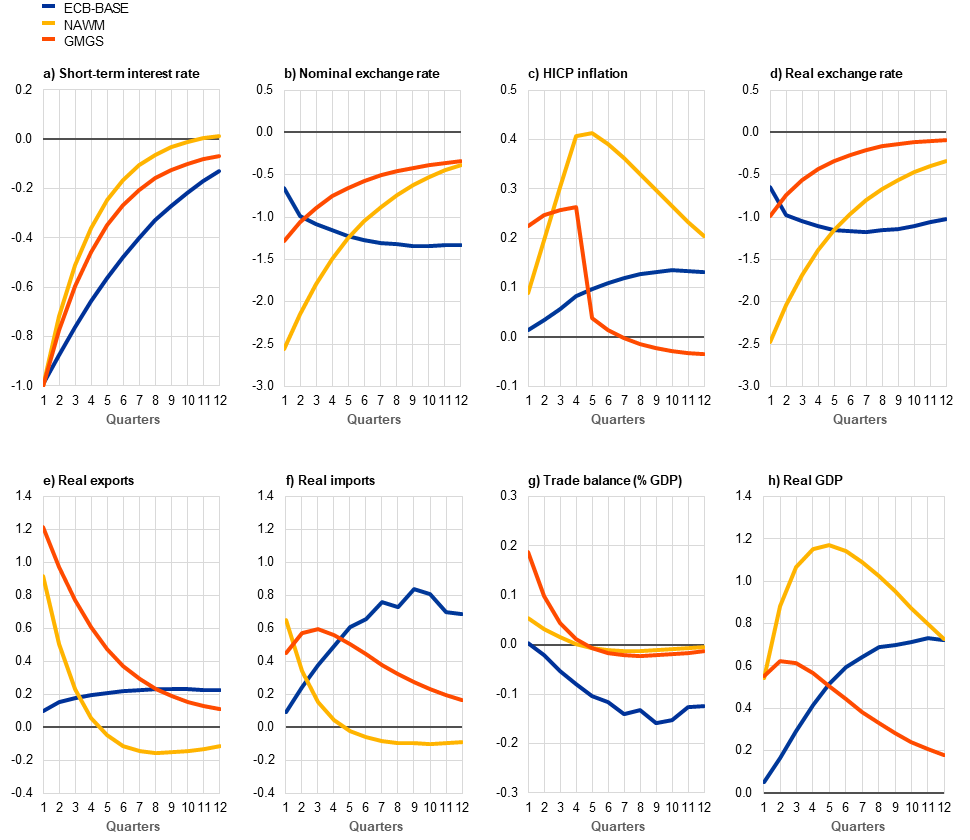
The impulse responses show the effect of a surprise 100-basis point monetary policy easing (in annualised terms; see Chart 6, panel a). The shock lowers domestic interest rates relative to foreign interest rates, triggering asset outflows that result in a nominal and real exchange rate depreciation (Chart 6, panels b and d). In the ECB-BASE model, the reaction is less frontloaded, as it is linked to long-term yields, which react more sluggishly. In the GMGS model, the real depreciation is less pronounced than in the NAWM, as in the latter inflation responds more sluggishly due to partial backward indexation and stickiness also affecting importers.
The depreciation makes domestic goods cheaper relative to foreign goods, improving price competitiveness in international markets. As the domestic currency depreciates, foreign demand for domestically produced goods increases, leading to an increase in real exports (Chart 6, panel e). The increase is more sluggish in the ECB-BASE model, reflecting the slower adjustment of the real exchange rate and a shock transmission mechanism with backward-looking expectations.
On the import side, two opposing forces come into operation following the monetary policy easing, as both import prices and domestic demand increase. On the one hand, the weaker exchange rate raises the domestic currency price of foreign goods, which tends to reduce imports. On the other hand, monetary easing stimulates overall domestic demand, including for imported goods. In the GMGS and the NAWM models, the demand effect slightly outweighs the price effect, leading to an increase in real imports, which is more limited than the increase in exports (Chart 6, panel f). Therefore, there is an improvement in the trade balance (Chart 6, panel g). By contrast, the domestic demand effect is stronger in the ECB-BASE model, as – which has a high import content – increases in response to the shock, leading to a deterioration in the trade balance. In the longer term, the trade balance also deteriorates in the GMGS and NAWM models: as higher prices feed through to export prices, the initial boost to exports fades. By contrast, domestic demand remains stronger more persistently, keeping imports higher for longer.
Chart 6
Model-based impulse responses to a surprise monetary policy expansion
Panels a), c) and g): percentage point deviations from steady state.Panels b), d), e), f) and h): percentage deviations from steady state.
Sources: ECB staff calculations based on the ECB-BASE model (Angelini et al., 2019), NAWM II model (Coenen et al., 2018) and the GMGS model (Gnocato, Montes-Galdon and Stamato, 2025).
Notes: In panels b) and d), a negative value indicates domestic currency depreciation.
Overall, the results align with the empirical evidence shown in the context of my keynote speech at the CEPR International Macroeconomics and Finance Programme Meeting in 2019.[12] Empirically, a monetary policy easing shock weakens the euro and stimulates both euro area exports and imports. In net terms, the trade balance improves as the response of exports is stronger than the increase in imports.
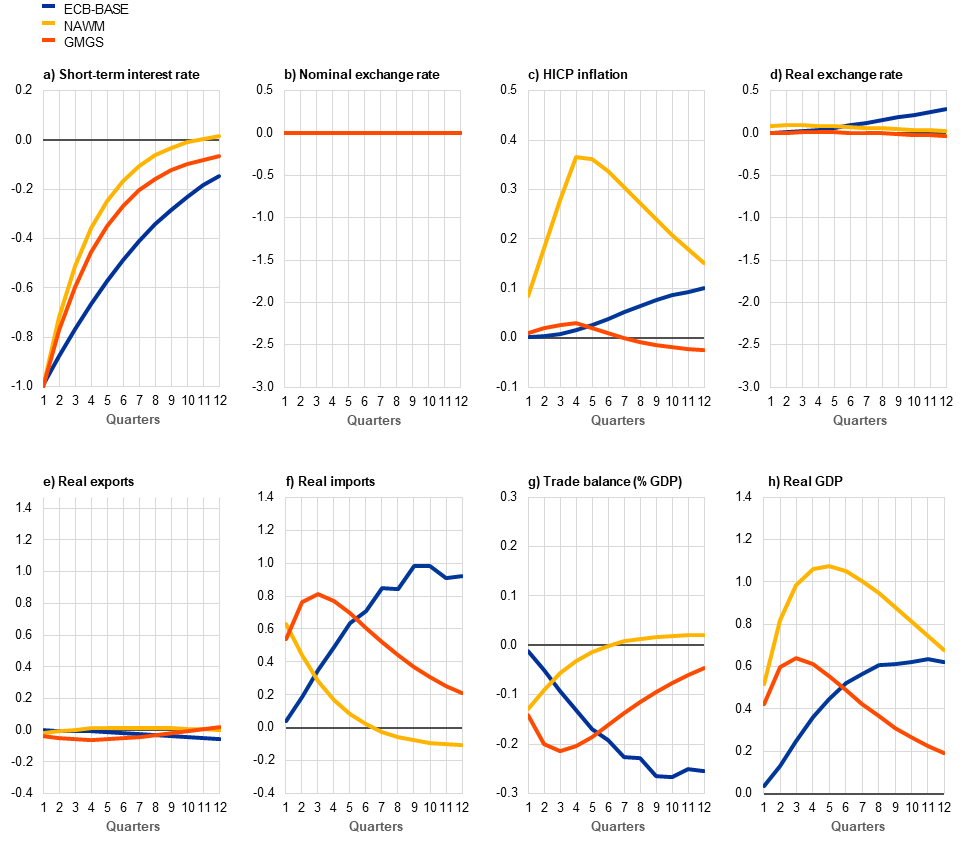
In order to obtain a better understanding of the importance of the role of the exchange rate in the transmission of monetary policy, it is helpful to “switch off” this channel in an alternative simulation exercise. The model simulations in Chart 7 examine the same policy trajectory as those in Chart 6, but with the nominal exchange rate held constant.[13] Under this counterfactual scenario, exports would remain largely stable as they would no longer benefit from improved terms of trade (Chart 7, panel e), while imports would grow more significantly due to the absence of currency depreciation, which would prevent foreign goods from becoming more expensive (Chart 7, panel f).
As a result, the trade balance would worsen (Chart 7, panel g), leading to a somewhat smaller increase in GDP (Chart 7, panel h). In addition, the rise in inflation would be smaller (Chart 7, panel c), as the absence of currency depreciation would prevent imports from becoming more expensive. In summary, in response to an easing impulse, the depreciation in the exchange rate strengthens the impact of monetary policy on output and inflation.
Wrapping up, the aim of this part of the speech has been to explain some of the analytical approaches used by the ECB staff to understand the macroeconomic role of the exchange rate. Of course, the exchange rate is just one variable among many in determining euro area macroeconomic dynamics and our overall evaluation of economic and financial developments is based on an integrated assessment of all relevant factors.
Chart 7
Model-based impulse responses to a surprise monetary policy expansion, shutting down the exchange rate channel
Panels a), c) and g): percentage point deviations from steady state.
Sources: ECB staff calculations based on the ECB-BASE model (Angelini et al., 2019), NAWM II model (Coenen et al., 2018) and the GMGS model (Gnocato, Montes-Galdon and Stamato, 2025)
Notes: In panel b) and d) a negative value indicates domestic currency depreciation.
The views expressed in this speech are personal and should not be interpreted as representing the collective view of the Governing Council of the ECB.
I am grateful to Tilman Bletzinger, Lea Demuth, Luca Fosso, Nicolò Gnocato, Antoine Kornprobst, Ana-Simona Manu, Giulia Martorana, Eve Samani, Viktória Vidaházy and Srečko Zimic for their contributions on this topic.
Bauer, M., Pflueger, C. and Sunderam, A. (2024), “Perceptions about Monetary Policy“, Quarterly Journal of Economics, 139(4), pp. 2227-2278.
The origin of the inflation deviation also matters for the calibration of the monetary policy response in the case of “large, sustained” deviations. Although inflation peaked above 10 per cent in late 2022, the ECB’s monetary policy took into account the characteristics of the inflation shock (with a heavy supply shock contribution) and eventually judged that a peak policy rate of 4 per cent would be sufficient to return inflation to target.
In what follows, I focus on supply-driven energy price shocks. Shifts in global demand can also generate fluctuations in the relative price of energy but have a wider impact on global inflation dynamics. During the pandemic, there were supply bottlenecks initially in the goods sector (as the global trading system struggled with a surge in demand for goods at the same time as supply capacity was interrupted) and subsequently in the services sector (as the economy reopened).
While food inflation exhibits relatively higher short-term volatility than core inflation, food inflation has become increasingly persistent over time, such that persistence indicators for non-energy inflation are broadly similar to those for core inflation. Since the food category makes up about 20 per cent of the HICP, the greater breadth of the non-energy inflation indicator is an important advantage over core inflation. It is also important to take into account inflation measures at different frequencies. For instance, a surge in energy inflation in the first quarter of 2025 that was quickly reversed means that there will be a substantial negative base effect in annual measures of energy inflation in early 2026, even though the energy price level has been broadly flat since the spring of 2025.
See also Nakamura, E., Riblier, V. and Steinsson, J. (2025), “Beyond the Taylor rule,” NBER Working Paper, No. 34200.
For details of the model, see Angelini, E., Bokan, N., Ciccarelli, M., Lalik, M. and Zimic, S. (2025), “The ECB-Multi Country Model. A semi-structural model for forecasting and policy analysis for the largest euro area countries”, Working Paper Series, No 3119, ECB.
For more details on the Macro-Finance FCI, see Lane, P.R. (2025), “The transmission of monetary policy: financial conditions and credit dynamics”, welcome address at the 5th WE_ARE_IN Macroeconomics and Finance Conference, 21 October, and Bletzinger, T., Martorana, G. and Mistak, J. (forthcoming), “Looser, Tighter, Clearer: a new Financial Conditions Index for the euro area”, mimeo. Related slides are also available; see Bletzinger, T., Martorana, G. and Mistak, J. (2025), “Looser, Tighter, Clearer: a new Financial Conditions Index for the euro area”, slides presented at the IMFS conference on ”Monetary and Financial Stability and Macro-Financial Modelling”, 7 November.
The reduced-form nature of FCI exercises mean that it is not possible to disentangle the financial and trade channels of currency movements.
For details, see Gnocato, N., Montes-Galdón, C. and Stamato, G. (2025), “Tariffs across the supply chain”, Working Paper Series, No 3081, ECB, Frankfurt am Main.
Lane, P.R. (2019), “The international transmission of monetary policy”, keynote speech at the CEPR International Macroeconomics and Finance Programme Meeting, 14 November.
This is achieved by means of a concomitant sequence of shocks to the risk premium on foreign asset holdings.
Europäische Zentralbank
Generaldirektion Kommunikation
- Sonnemannstraße 20
- 60314 Frankfurt am Main, Deutschland
- +49 69 1344 7455
- media@ecb.europa.eu
Nachdruck nur mit Quellenangabe gestattet.
Ansprechpartner für Medienvertreter